
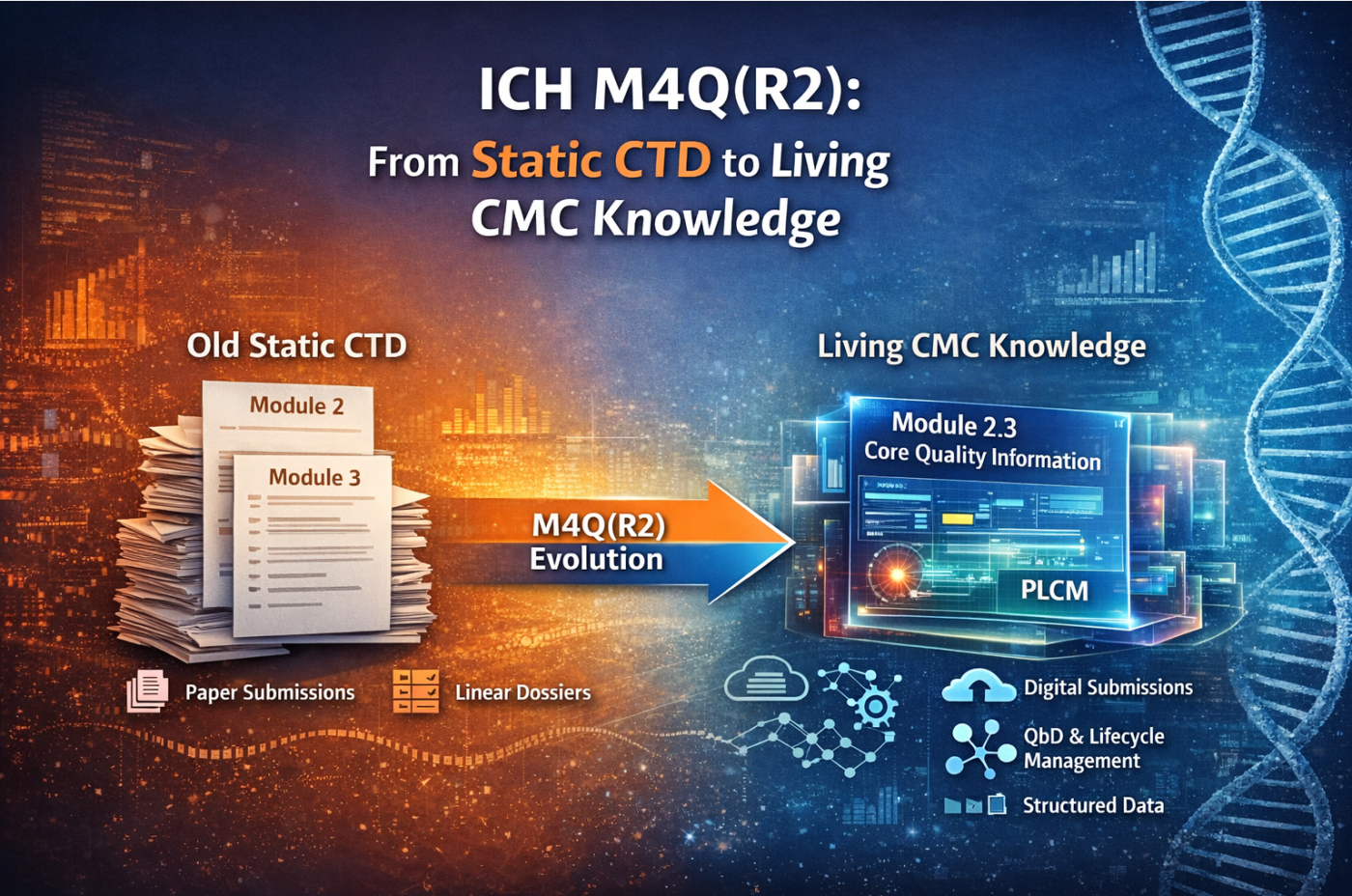
When the ICH M4 guideline was finalized more than twenty years ago, the Common Technical Document (CTD) represented a major milestone for global regulatory harmonisation. For the first time, regulators and industry shared a common structure for presenting pharmaceutical quality information.
But the world of CMC has changed dramatically since then.
The draft ICH M4Q(R2) shows just how far expectations for quality data, dossier structure and lifecycle management have evolved. What is proposed is not simply an update to Modules 2 and 3. It is a structural rethink of how pharmaceutical quality knowledge is organised, justified and maintained across the entire product lifecycle.
For companies, this will likely require more than revising dossier templates. It may require rethinking how CMC knowledge itself is managed internally.
Why the ICH M4Q(R2) Revision Was Needed
The current ICH M4Q(R1) guideline provided industry with a harmonised backbone for quality information, but it was designed in a very different regulatory environment. The CTD was originally conceived for paper submissions and later adapted for electronic formats, but its structure still reflects that legacy: long narrative sections, limited structuring and only implicit connections to modern regulatory concepts.
Over the past two decades, several developments have gradually exposed the limitations of that approach.
First, the ICH Quality guideline series has expanded significantly, particularly with the introduction of Q8 through Q14, bringing concepts such as Quality by Design (QbD), lifecycle management and Established Conditions (ECs) firmly into regulatory practice.
Second, product modalities have diversified. Biologics, advanced therapies, and complex combination products do not always fit comfortably into a structure originally designed with small molecules in mind.
Third, regulatory systems have moved toward fully electronic and increasingly digital submissions. With the introduction of eCTD v4.0 and growing interest in structured, machine-readable data, regulators are now looking beyond static documents toward more data-driven regulatory assessment.
Against this background, regulators have been explicit about the objectives of the revision:
- to establish ICH M4Q(R2) as the primary reference for the structure and location of quality information
- to integrate modern ICH Quality concepts
- and to enable more efficient, data-driven regulatory assessment
What the Draft ICH M4Q(R2) Actually Changes
The draft ICH M4Q(R2) guideline, endorsed as a Step 2 document in May 2025 and currently under public consultation, introduces a significantly re-engineered structure for Modules 2.3 and 3. While many underlying regulatory expectations remain unchanged, the organisation and logic of the dossier are fundamentally redesigned.
Several changes stand out.
1. Module 2.3 Becomes the Primary CMC Narrative
In the traditional M4Q(R1) framework, the Quality Overall Summary (QOS) in Module 2.3 was often treated as a secondary deliverable — essentially a condensed restatement of Module 3 written late in the submission process.
The draft ICH M4Q(R2) reverses that logic.
Module 2.3 is repositioned as the primary regulatory narrative for quality, while Module 3 is explicitly described as the body of supporting data.
The revised QOS structure contains six subsections:
- 2.3.1 Product Overview
- 2.3.2 Overall Development and Control Strategy
- 2.3.3 Core Quality Information (CQI)
- 2.3.4 Development Summary and Justification
- 2.3.5 Product Lifecycle Management (PLCM)
- 2.3.6 Quality Benefit–Risk Considerations
Among these, three sections are particularly influential.
2.3.2 Overall Development and Control Strategy
This section is intended to integrate the Quality Target Product Profile (QTPP), Critical Quality Attributes (CQAs), and the overall control strategy into a coherent narrative explaining how product quality is ensured.
2.3.3 Core Quality Information (CQI)
This concept introduces a curated set of key quality data elements that must remain consistent and up to date throughout the product lifecycle.
2.3.5 Product Lifecycle Management (PLCM)
Here the guideline integrates lifecycle concepts from ICH Q12, including Established Conditions (ECs), change management protocols and post-approval lifecycle commitments.
Perhaps the most significant conceptual shift is this:
Module 3 sections are now expected to support the narrative presented in Module 2.3, rather than the other way around.
For many organisations accustomed to the traditional workflow, this represents a substantial change in how CMC dossiers are authored.
2. Module 3 Reorganised Around the DMCS Model
One of the most visible structural changes in ICH M4Q(R2) is the introduction of the DMCS model — Description, Manufacture, Control, Storage.
This model acts as a consistent organisational logic for Module 3 content.
Each material class — including drug substances, intermediates, excipients, drug product components and device elements — is organised using the same DMCS framework.
Within these sections, the guideline introduces mandatory and optional keywords designed to improve consistency, facilitate navigation and support future digitalisation.
According to the draft guideline, this increased granularity is intended to:
- improve clarity in where information should reside
- facilitate digital data handling and analysis
- support more efficient regulatory review
Regulators emphasise that the aim is not to introduce new regulatory requirements but rather to clarify the structure and reduce duplication.
In practice, however, the redistribution of information from traditional sections such as S.2.2 or S.2.4 into multiple DMCS-based subsections will require significant adaptation. Without clear examples and guidance, there is a risk that the new structure could initially make dossiers appear more complex rather than simpler.
3. An Explicit Move Toward Digital CMC
One of the most striking aspects of the draft ICH M4Q(R2) is its explicit reference to digitalisation and structured data.
The guideline describes the proposed structure as:
“Presented in a globally harmonised format with sufficient granularity to facilitate digitalisation and organised for easy access, analysis, and knowledge management.”
It also highlights compatibility with emerging technologies such as:
- advanced manufacturing
- AI and machine learning
- bioinformatics
- advanced analytical tools
Although the guideline does not mandate specific file formats or data schemas, the direction is clear. The structure is designed to support structured, modular, machine-readable CMC information.
In practical terms, this implicitly pushes organisations toward Digital CMC infrastructures capable of:
- maintaining a consistent Core Quality Information dataset
- linking lifecycle changes to underlying CMC knowledge
- generating regulatory content dynamically rather than relying on static documents
For companies already modernising their regulatory information management systems, this is a natural evolution. For others, it may represent a significant transformation.
4. Broader Scope Across Modalities and Product Types
The revision broadens the explicit scope of M4Q to “all pharmaceutical drug substances and products (both chemical and biological)” and clarifies expectations for more complex configurations.
Public presentations and comment documents highlight dedicated structures or explicit consideration for:
- Starting/source materials, raw materials, intermediates, packaged multi‑constituent products
- Medical devices used in combination products and products after transformation (e.g. reconstituted forms)
This makes M4Q(R2) a more realistic framework for biologics, ATMPs and combination products, though the level of prescriptive detail varies, and some stakeholders are already asking for more examples to avoid inconsistent interpretation.
Timelines and Regulatory Ambition
According to the ICH workplan and associated slide decks, the path from Step 2 draft to final adoption is ambitious.
- Step 2 endorsement and release for public consultation occurred in 2025.
- Public workshops and consultations are planned through 2025–2026, with review and resolution of comments targeted by late 2026.
- Step 3 sign‑off and Step 4 final adoption are currently envisaged around mid‑2027.
Some observers have questioned whether this window is realistic for such a transformative guideline, especially given the need to align regional procedures, IT systems, and assessment templates. Nonetheless, regulators underline that ICH M4Q(R2) is expected to deliver tangible benefits: streamlined assessment, more efficient data analysis and automation, improved lifecycle oversight and more consistent decision‑making.
Critical Reading: Strengths and Open Questions
From a CMC and regulatory perspective, the draft ICH M4Q(R2) is both promising and demanding. A critical reading brings several strengths—but also some open issues—to the surface.
Strengths
A clearer role for Module 2.3
The shift to a strong, structured Module 2.3 that drives assessment, with Module 3 as a supporting body of data, aligns well with science‑ and risk‑based review. It should, in principle, reduce redundancy and focus reviewers on what matters: control strategy, lifecycle tools, and benefit–risk considerations.
Alignment with lifecycle management concepts
By explicitly integrating Established Conditions, PLCM documents and change management frameworks, ICH M4Q(R2) brings the CTD structure closer to the lifecycle thinking introduced by ICH Q12.
For organisations already working within a Quality by Design framework, this creates welcome coherence between development strategy and regulatory documentation.
A foundation for Digital CMC
The increased structural granularity and the emphasis on consistent data elements provide a foundation for structured CMC information management.
This aligns with ongoing industry efforts to build Digital CMC ecosystems, where regulatory submissions are generated from structured data rather than manually assembled documents.
Open Questions
Complexity versus clarity
While DMCS and keyword‑based structuring are intended to improve clarity and harmonisation, the redistribution of content from M4Q(R1) into multiple new subsections risks making dossiers more difficult to navigate if not accompanied by good examples. Early regulator comment summaries indicate that industry is concerned about duplication and ambiguity around what belongs in Module 2.3 versus Module 3.
“Structured” but not fully standardised
ICH M4Q(R2) stops short of defining a universal data model or eCTD schema for CMC data. This gives sponsors flexibility, but it may also lead to divergent implementations of “structured” submissions and limit interoperability unless regulators follow up with more prescriptive technical specifications.
Implementation burden and readiness
The benefits of ICH M4Q(R2) will not materialise automatically. Companies will need to:
- redesign internal dossier templates
- train multidisciplinary teams
- potentially implement new digital CMC and knowledge management platforms
Organisations with limited digital maturity may find the transition particularly challenging.
Integration with existing regional frameworks
Even with a harmonised ICH guideline, regulatory systems differ across regions. Differences in legislation, submission infrastructure and review practices may lead to varying interpretations during the first years of implementation.
What CMC and Regulatory Teams Should Do Now
Even though ICH M4Q(R2) is still a draft, waiting passively is not a viable strategy. The direction of travel is clear enough to justify concrete steps.
Map your current dossiers against the ICH M4Q(R2) structure
- Perform a gap assessment of representative products against the draft Module 2.3 and DMCS‑based Module 3.
- Identify where key elements such as QTPP, CQAs, Overall Control Strategy, ECs and PLCM information are currently located—and how easily they could be re‑organised.
Clarify ownership of key narratives
- Decide who “owns” the Overall Development and Control Strategy section and the PLCM narrative across RA, CMC development, QA/QC and supply chain.
- Ensure that decisions on control strategy and change management are captured in a way that can be reused across multiple submissions and lifecycle events.
Invest in CMC data and knowledge infrastructure
- Evaluate whether current systems can support a coherent Core Quality Information dataset that remains aligned across Module 2.3 and 3, as well as across variations and renewals.
- Consider implementing structured data repositories or knowledge management platforms that can feed both authoring and regulatory submissions.
Engage actively in the consultation process
- Use the public consultation period and regional mechanisms (e.g. EMA, MHRA, FDA consultations) to raise practical concerns, especially where the draft is ambiguous on level of detail or location of information.
- Follow workshop outputs, ICH slide decks and emerging Q&A documents, which are likely to provide important clarifications and early regulatory expectations.
Conclusion: A New Era for CTD Quality – If Industry Is Ready
ICH M4Q(R2) is more than a structural tweak to the CTD; it is a move toward a living, data‑centric representation of product quality that tightly integrates development, control and lifecycle management. For companies willing to invest in Digital CMC and robust internal knowledge management, the draft offers a coherent framework to align regulatory dossiers with how products are actually developed and managed.
For everyone else, it is a clear signal: the era of static, narrative‑heavy quality submissions is coming to an end. The real question is not whether ICH M4Q(R2) will arrive in some form, but whether organisations will be ready to use it as an opportunity to modernise their CMC practices rather than treating it as a compliance burden.
Further information on the draft guideline can be found on the European Medicines Agency website.
Article written by Angelo Leone
© 2026 PharmaLexica. All rights reserved.
This article may not be reproduced or republished without permission. Please cite the author and source if referencing this work.